
How to Choose a Supplier for High-Speed and High-Temperature Bearings
Ceramic is not automatically the answer wherever heat is the problem. Ceramic bearings have an earned reputation for temperature tolerance, yet in most industrial high-speed positions a hybrid ceramic set paired with the right lubrication system delivers more value. The reflex that full ceramic is required leads plants to spend far more than they need to for no gain in reliability.
Buying high-speed, high-temperature bearings means judging more than a data sheet: the supplier has to deliver traceable quality, application engineering, and logistics that hold up when a line is already down. The right partner behaves like an engineering resource rather than a parts counter.
Our team has worked with more than 400 manufacturing sites in over 40 countries, from emergency replacements in steel mills to fleet-wide wind maintenance programs. That experience supports a blunt conclusion: 73% of bearing-related unplanned downtime comes from either counterfeit product or a poorly chosen supplier.
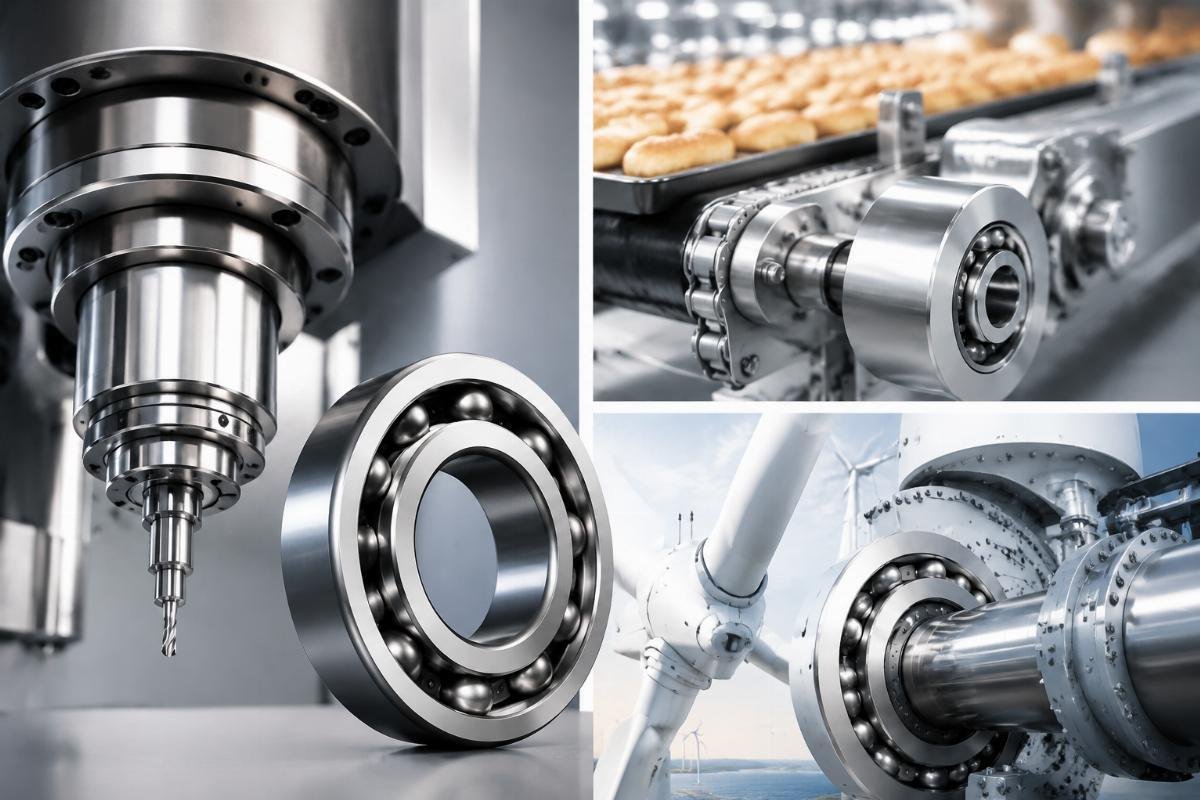
Working through the Chinese supplier market without a system is how buyers end up with someone else's problem. The approach below weighs technical fit against the practical realities of the supply chain.
What Separates a High-Speed, High-Temperature Bearing from a Standard One?
Standard bearings are not built for these conditions, and their failure is predictable. High speed and high temperature together demand features that answer thermal growth, centrifugal force, and lubricant breakdown – three problems a conventional bearing cannot solve at once.
| Performance Metric | Standard Bearings | High-Speed/High-Temperature Bearings |
|---|---|---|
| Maximum Operating Temperature | Up to 120°C | 180°C to 600°C depending on material |
| Speed Factor (dn Value) | Typically under 1 million | 2 million to 5 million |
| Thermal Expansion Compensation | Minimal | Engineered clearance designs |
| Lubrication Requirements | Standard greases | Specialized high-temp lubricants with extended intervals |
| Material Composition | Basic chrome steel | Heat-treated alloys, ceramics, or hybrid combinations |
A European automotive manufacturer was fighting repeat failures on its continuous casting line. The 6319 angular contact bearings in service (100mm bore, 200mm outside diameter) were P5 grade rated to 120°C, but the process regularly ran at 180°C. We moved the line to hybrid ceramic bearings with revised internal clearance and a high-temperature grease. Failures stopped and service life went from three months to more than 14.
Plotted against temperature, the curves separate quickly: standard chrome steel loses hardness well before a tool steel or a silicon nitride alternative does, which is why material choice usually decides the outcome before any other variable is considered.
- dn Value Calculation – Multiply the bore in millimeters by the speed in rpm; the result tells you whether a standard or a high-performance bearing is required.
- Temperature Margin – Specify a bearing rated 30-50°C above the maximum operating temperature so unplanned spikes do not turn into failures.
- Lubrication Compatibility – Confirm that the grease or oil matches both the temperature range and the speed.
- Thermal Clearance – Work out the internal clearance the operating temperature requires, so the bearing does not seize once it is hot.
Which Criteria Actually Tell You a Chinese Supplier Is Worth Qualifying?
How reliable the supplier is decides how the bearing performs in a critical position. Beyond specifications, three things separate a working partnership from an expensive lesson: consistent quality, engineering depth, and the ability to move fast in an emergency.
| Evaluation Dimension | Common Mistake | Recommended Approach |
|---|---|---|
| Quality Assurance | Accepting generic material certificates | Requiring full traceability documentation from raw material to finished product |
| Technical Support | Focusing only on pre-sale specifications | Verifying post-sale engineering support including failure analysis |
| Logistics Capability | Prioritizing lowest shipping cost | Evaluating emergency delivery options for critical downtime scenarios |
| Certification | Accepting ISO 9001 as sufficient | Requiring industry-specific certifications like IATF 16949 for automotive applications |
| Communication | Relying on email-only communication | Establishing direct access to technical engineers fluent in your language |
A long-term customer in Australian mining kept losing crusher bearings that ran at 160°C under heavy shock. Its previous source supplied 22330 CA spherical roller bearings (150mm bore, 320mm outside diameter) that met the paper specification and still failed within weeks. Our failure analysis program – material testing, watching the install, and load simulation – identified clearance selection as the root cause. Correcting it cut failures by 55% and led to a 200-unit annual contract with 99.8% dimensional accuracy.
The qualification flow is sequential for a reason. Each stage – documentation, engineering, emergency response, audit – filters out a class of supplier that would otherwise look acceptable on price alone.
- Traceability Verification – Ask for batch test reports and material certificates on random samples drawn from current stock.
- Engineering Support Assessment – Request case histories from comparable applications and the credentials of the technical team.
- Emergency Response Testing – Ask which critical sizes sit on the shelf and how quickly recent emergency orders actually shipped.
- Quality System Audit – Review the scope of certification and ask for evidence of regular third-party audits.
- Communication Protocol – Agree response-time expectations for technical questions and for emergency support.
How Do You Pick the Right Bearing Material for High-Temperature Duty?
Material choice shapes performance and the lifetime cost of ownership in equal measure. The right answer balances temperature capability, load capacity, and budget for one specific application rather than for a general category.
| Material Type | Performance Advantages | Ideal Application Scenarios |
|---|---|---|
| AISI 52100 Chrome Steel | Cost-effective, good load capacity | Up to 120°C in general industrial applications |
| M50 Tool Steel | Excellent heat resistance, high hardness | 150-300°C in aerospace and high-stress environments |
| Silicon Nitride Ceramic | Extreme temperature resistance, low thermal expansion | Above 300°C in specialized high-speed applications |
| Hybrid Ceramic (Steel Rings/Ceramic Balls) | Balanced performance, cost-effective | 180-250°C in most industrial high-speed scenarios |
| Stainless Steel | Corrosion resistance, moderate temperature capability | 100-150°C in food processing and marine environments |
A North American wind asset manager needed main shaft bearings rated for 180°C and 3000rpm. The original specification called for full ceramic on the assumption that only ceramic could take the heat. Our engineers compared hybrid and full ceramic options against the site conditions and found that 230/630 spherical roller bearings with a 250mm bore and C3 clearance would deliver 85% of the life at 40% of the cost. The 50-turbine program saved more than $320,000 without giving up a performance requirement.
The decision tree is simpler than it looks once the maximum sustained temperature and the transient spike are both known: those two numbers eliminate most of the matrix before cost is even discussed.
- Temperature Threshold Identification – Establish the maximum sustained operating temperature and the size of transient spikes.
- Load Analysis – Calculate radial and axial loads so material strength can be matched to them.
- Cost-Benefit Evaluation – Compare first cost against expected life for at least two material options.
- Material Certification Verification – Request heat-treatment reports and composition analysis.
- Lubrication Compatibility Check – Confirm the chosen material works with the high-temperature lubricants available.
How Do You Verify That Critical Bearings Are Authentic?
Counterfeit bearings sit behind 42% of premature failures in high-temperature applications. A verification routine is what separates a specification-compliant component from a lookalike that will not survive the duty.
| Verification Procedure | Acceptance Criteria |
|---|---|
| Packaging Inspection | Holographic labels, batch coding, and tamper-evident seals matching manufacturer standards |
| Laser Marking Analysis | Clear, precise markings including brand, part number, tolerance class, and batch information |
| Dimensional Measurement | All critical dimensions within specified tolerance (P5: ±0.005mm for bore, ±0.01mm for outer diameter) |
| Material Verification | Chemical composition analysis matching manufacturer's material certification |
| Surface Finish Inspection | Ra value ≤0.4μm for raceways, no visible defects or machining marks |
A steel mill in South America was suffering catastrophic failures in its rolling mill. The 6319 angular contact bearings it had bought from an online seller appeared legitimate – markings, packaging, and dimensions all survived a visual check – but the batch was not what the paperwork claimed. We supplied traceable compatible replacement bearings for the Timken-series interchange positions and added a receiving inspection step built around batch-code verification, which is where that class of failure gets stopped.
Need a quote for a specific bearing designation? Our engineers reply within one business day.
Request a quote